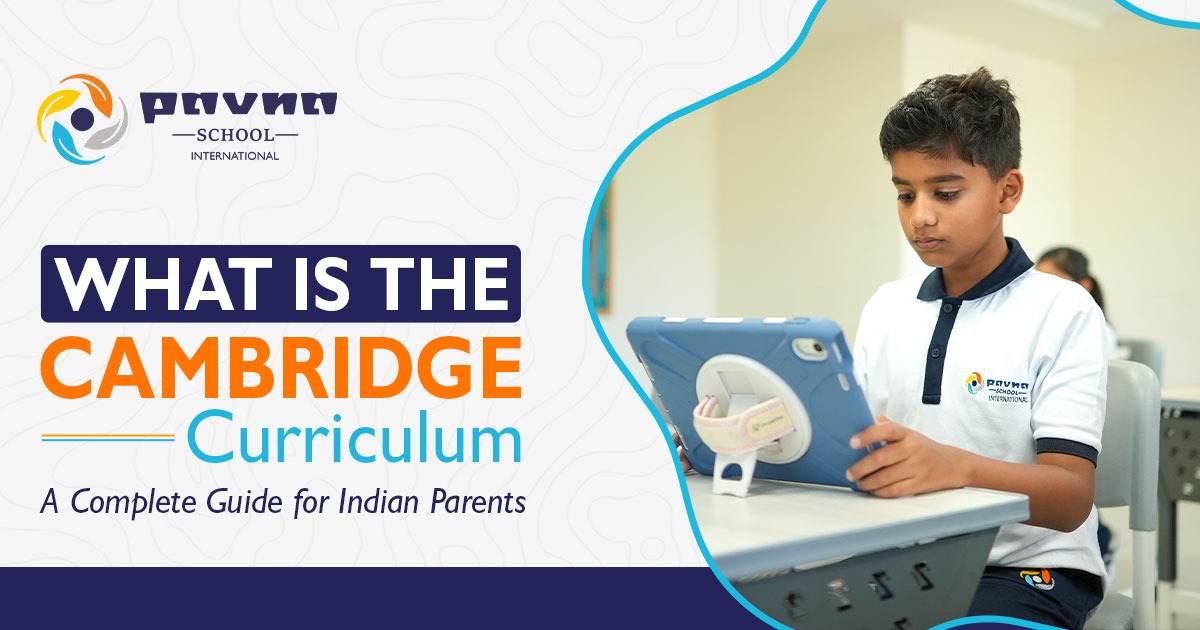
When exploring schools in India, parents usually come across familiar options such as CBSE and ICSE. Then there is Cambridge, an international curriculum that follows a somewhat different approach to learning. This often raises a few questions: what is the Cambridge board, how does it work, and will it suit your child’s future plans?
Understanding how the curriculum works can help you make a more informed decision.
What Is the Cambridge Board?
Cambridge International Education is a part of Cambridge University Press & Assessment, which develops educational programmes and qualifications for schools worldwide. It is also called the Cambridge Board; it does not run schools. Instead, registered schools use its curriculum framework and offer examinations.
This means children can study the Cambridge curriculum in India without moving abroad. The school delivers the lessons, while Cambridge provides the framework for teaching, learning and assessment.
Understanding the Cambridge Pathway: Ages 3 to 19
The Cambridge Pathway covers five stages, from early childhood education to advanced studies. Each stage builds on earlier learning and helps students develop the skills they need as they progress.
1. Cambridge Early Years (ages 3–5)
Young children learn through play, exploration and interaction. The focus extends beyond early academic skills to physical development, language and communication, thinking skills, and social and emotional development.
For example, sorting objects by colour or size can introduce basic mathematical ideas, while storytelling helps children develop vocabulary and express themselves. Activities are designed to encourage curiosity, confidence and interaction with others.
2. Cambridge Primary (ages 5–11)
At this stage, children develop their foundations in English, Mathematics and Science. Depending on the school, they may also study Hindi, Global Perspectives, Physical Education, Music, Art and Design, and Information and Communication Technology.
Learning can include practical activities, discussions and problem-solving tasks. Cambridge Primary Checkpoint assessments are also available to help schools understand students’ progress at the end of the programme.
3. Cambridge Lower Secondary (ages 11–14)
Students explore familiar subjects in greater detail while developing more independent learning habits. Alongside core subjects, they may study areas such as Global Perspectives, Computing, Art and Design, and Design and Technology.
The aim is to help students ask questions, explain their reasoning and apply what they learn. This stage also prepares them for the more specialised subjects and qualifications available in upper secondary education.
4. Cambridge Upper Secondary (ages 14–16)
Students can work towards Cambridge IGCSE, an internationally recognised qualification generally taken around the Class 10 level.
One feature parents may appreciate is the range of subject choices. Depending on availability, students can explore languages, humanities, sciences, Mathematics, and creative or professional subjects.
The assessment approach encourages students to understand concepts and apply their knowledge. For example, a Science question may ask them to interpret experimental results rather than simply recall a definition.
5. Cambridge Advanced (ages 16–19)
At this stage, students can pursue Cambridge International AS & A Level qualifications. They study subjects in greater depth and can plan their choices around their intended university courses.
For instance, a student considering engineering may choose Mathematics and Physics alongside other relevant subjects. Someone interested in business may prefer subjects such as Business, Accounting or Economics, depending on their goals and the university’s requirements.
AS Level is typically a one-year qualification, while A Level is generally a two-year course. These qualifications can support university applications in India and abroad, subject to individual admission requirements.
How Is the Cambridge Syllabus Different?
The Cambridge syllabus focuses on understanding subject content and applying knowledge. This can make learning different from an approach based mainly on memorising textbook answers.
- Conceptual understanding: Students may need to explain why something happens, interpret information or solve unfamiliar problems.
- Subject flexibility: At higher levels, students can choose subjects that reflect their interests and future plans.
- Independent thinking: Research, analysis and communication help students develop the ability to explain and support their ideas.
- International perspectives: Lessons can introduce examples and issues from different parts of the world.
This approach may suit children who enjoy exploring ideas and asking questions. Students who are more accustomed to memorising answers may need time to adjust to different assessment styles.
Cambridge Curriculum in India: What Parents Should Know
Before choosing an international curriculum, parents should consider how it fits into India’s education system, especially if their child plans to attend an Indian university.
Is Cambridge recognised in India?
Cambridge qualifications are accepted by many Indian institutions, subject to their admission requirements and applicable equivalence rules.
Check the latest requirements with the relevant university or authority before making a decision.
Can Cambridge students take JEE, NEET or CUET?
Students following Cambridge qualifications may apply for these entrance examinations if they meet the applicable eligibility criteria.
Those considering engineering or medicine should check the required subjects, qualifying examinations and minimum marks. Reviewing the current official rules early can help families choose suitable subjects and plan any additional preparation.
Is Cambridge suitable for studying abroad?
Cambridge qualifications can support university applications overseas. A Levels are widely used for university admissions, particularly in the UK, and are accepted by institutions in many other countries.
However, universities may require specific subjects, grades, English-language qualifications or additional tests. Students should check these requirements before finalising their subject choices.
Advantages of the Cambridge Curriculum
Cambridge offers several benefits to consider.
Advantages
- Globally Recognised Curriculum
- Conceptual and Application-Based Learning
- Student-Centred Assessment System
- Strong Foundation for Higher Education
- Holistic Development Approach
How to Choose the Right Cambridge School
Two schools offering the same curriculum can provide different learning experiences. Before enrolling your child, check these points:
- Registration: Confirm the school’s status through the official Cambridge International school directory.
- Teachers: Ask about teachers’ experience with Cambridge programmes and how they support students.
- Academic results: Review recent IGCSE and A Level results alongside the academic support available.
- Subject availability: Check whether the school offers subjects your child may need for future university applications.
- Assessment and guidance: Request sample papers and ask how the school supports students planning to take Indian entrance examinations.
Speaking with current parents can also help you understand the school’s teaching practices and student support.
Final Thoughts
Cambridge qualifications are widely accepted by universities and employers across the world. They provide students with opportunities to pursue higher education and career pathways both in India and internationally.
The Cambridge Pathway offers a progression from early childhood education to A Levels, with an emphasis on understanding, application and independent thinking. Reviewing subject choices, assessment methods and future study requirements can help you decide whether this international curriculum fits your child’s needs.