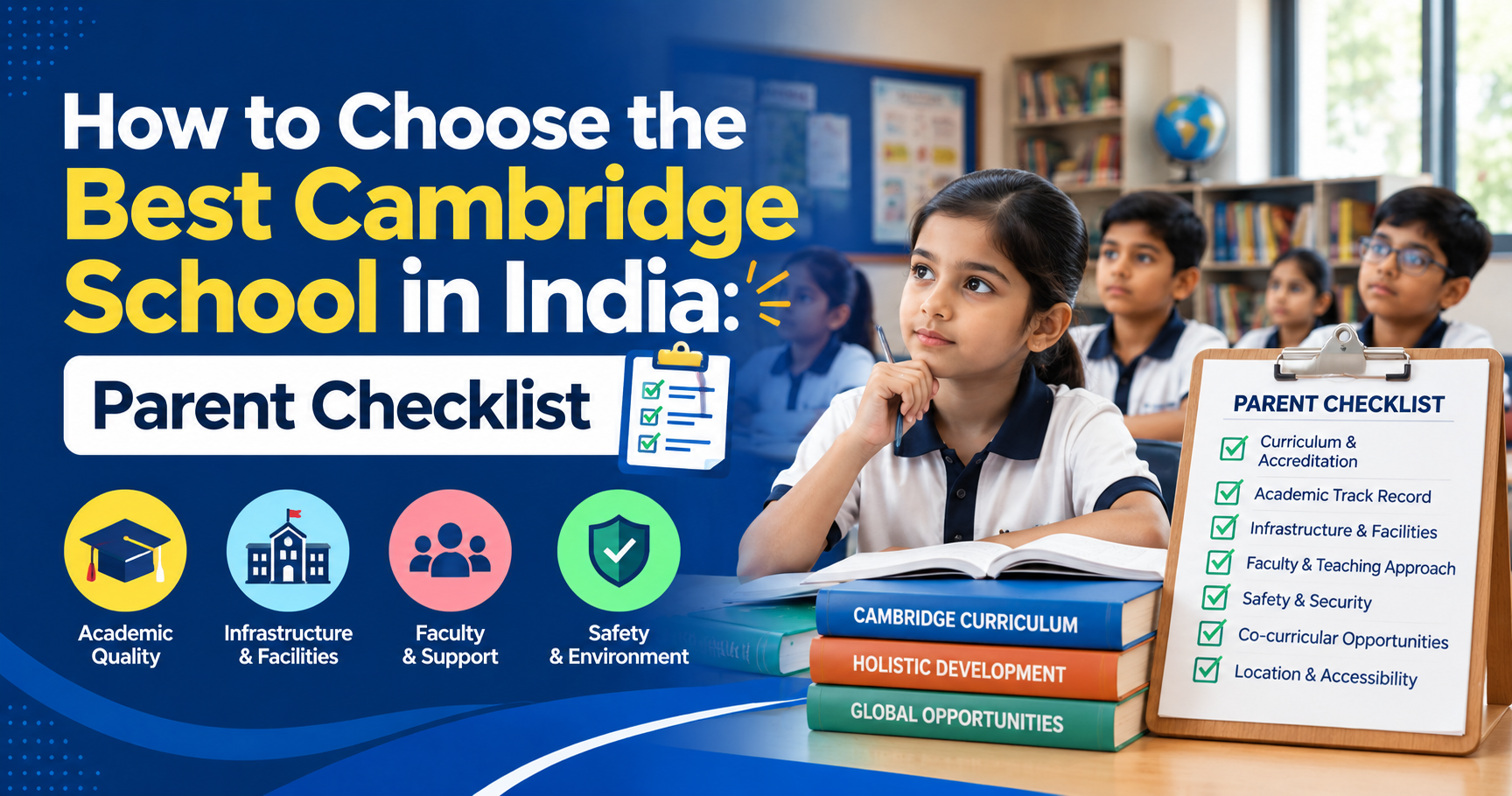
Choosing a Cambridge school in India is the most prestigious gift you can give to your child for their academics. Its curriculum is the best for any Indian student to get an international-level education. However, you are sure to find many Cambridge board schools in India and face confusion about which is actually the best one for your child. To find the best one, there are a lot of factors you need to evaluate among all schools, which include their teaching quality, approach towards assessments, fees, safety, student support, location, transport, and much more.
What to Check When Choosing the Best Cambridge Schools in India?
Before finalizing a school, you should shortlist a few schools based on what you expect from them according to all evaluation factors. The list of factors below is a checklist that you should keep with you when finding one of the best Cambridge schools in India.
1. Official Registration With Cambridge International
The first verification step is to confirm whether the school you are considering to shortlist for its Cambridge curriculum is actually registered with Cambridge International or not.
- Search for the school through Cambridge International’s official school directory.
- Confirm its Cambridge status.
- Ensure whether the school offers Cambridge Primary, Lower Secondary, IGCSE, AS & A Level, or any other programme.
2. Quality of Teaching
While the Cambridge International curriculum is strong, the quality of teaching and assessment offered by the school following this curriculum should be equally strong to make learning effective. While evaluating a school, you should ask how teachers actually plan lessons and provide feedback to the students.
- Ask about teacher qualifications and relevant subject experience.
- Find out whether teachers receive continuing professional development.
- Ask how frequently students receive academic feedback.
- Observe whether classrooms encourage students to ask questions and explain their reasoning.
3. How Are Students Assessed
With great teaching comes regular assessments for students to check whether the learning is turning out to be beneficial for students or not. This assessment is done in the form of theoretical and practical examinations.
- Ask how often students are assessed.
- Understand how internal tests contribute to academic monitoring.
4. Which Subjects Can Your Child Choose?
Cambridge International curriculum allows students to choose their desired subjects from over 70 subjects at the IGCSE level and over 50 subjects at the AS and A Level. The subjects a student chooses highly influence what academic path they walk in the future. However, different Cambridge curriculum schools offer different subjects rather than all of them.
- Get the subject list.
- Consider what subject groups your child can get.
5. Full Cost of Studying
Among all the Cambridge affiliated schools in India, the total fees vary. You should check the total cost and not the tuition fee of a school before shortlisting it. Additionally, check if the school offers any scholarship options or not. The following is what the total cost includes:
- Tuition fee
- Admission fee
- Examination fees
- Transport and meal charges
- Books and uniforms fee
- Charges for extracurricular activities
6. Safety and Child-Protection Systems
The safety of your child is one of the most important factors that you should properly evaluate and never rush through while considering a school of Cambridge board in India, especially when you are finding a Cambridge International school for girls.
- Ask about visitor management and the student pick-up process.
- Understand the school’s emergency response arrangements.
- Check how bullying and cyberbullying complaints are handled by the school.
- Ensure that school buses and vans provide safe transport.
7. Availability of Meals
A lot of schools in India provide the option of meals, while many do not. Check whether the Cambridge global school you are considering has food arrangements for your child or not. If they do provide food in the form of mid-day meals, then check whether they are hygienic or nutritious enough for the growth of your children.
- Ask what kind of meals are provided.
- Ask about vegetarian, allergy-sensitive, nutritious, and other dietary requirements.
- Understand how food is stored, prepared, and served.
- Check whether safe drinking water is available
8. Exposure to Sports and Physical Activity
Besides the theoretical and practical education, you should ensure whether children are offered participation in sports and exposed to various physical activities or not. This is important to consider as regular physical activities can contribute greatly to children’s physical health, teamwork, discipline, and social development.
- Check which indoor and outdoor sports are available.
- Ask how many physical-education periods students receive each week.
- Check whether trained coaches or PE teachers are available.
- Ask whether students can participate in inter-school competitions.
- Look at the quality and safety of sports facilities during the school visit.
| What to Check | Why It Matters |
| Cambridge registration | Confirms that the school is authorised to offer Cambridge programmes. |
| Teaching quality | Effective teaching determines how well the curriculum is implemented. |
| Assessment approach | Helps parents understand academic expectations and learning progress. |
| Subject choices | Subject availability can affect future academic and university options. |
| Total cost | Helps families understand the actual financial commitment. |
| Safety & child protection | Academic quality should be supported by a safe and secure learning environment. |
| School meals & nutrition | Nutritious and safe food can support children’s health and daily learning routine. |
| Sports & physical activity | Regular physical activity supports fitness, teamwork, and overall development. |
What Should Parents Observe During a School Visit?
Going for a school tour can reveal information that you can never get by reading a school’s brochure or reading about them online. The following is what you should do when exploring the campus of Cambridge syllabus schools:
- Classroom interaction with students
- Accessibility to teachers
- Cleanliness and maintenance
- Library, laboratories, and sports facilities
- Discipline among the students
- Communication between school staff and parents
- Overall atmosphere
Conclusion
When you are finding the best Cambridge school in India for your child’s admission, you will find that there is no school universally considered the best. Rather, what may appear as the best school to you depends on your own choices and needs. One of the schools you can consider for your child’s admission is Pavna International School, Sasni. Like this, you should ideally shortlist several schools as options before choosing one out of them all that you and your child can cherish.
Frequently Asked Questions (FAQs)
Q. Which Cambridge school in India is considered the best?
The list of best Cambridge schools in India includes a lot of schools, one of which is Pavna International School, Sasni.
Q. How to check if a school is Cambridge registered?
You can check if a school is Cambridge registered by searching its name in the “Find a Cambridge School” directory on the official website of Cambridge International Education.
Q. Is Cambridge curriculum recognised in India?
Yes, the Cambridge curriculum is officially recognized in India.
Q. Is Cambridge syllabus good for Indian students?
Yes, the Cambridge syllabus is good for Indian students as it helps them choose various subjects of their preference, develop critical thinking & other such skills, and get conceptual learning.
Q. How many Cambridge schools are there in India?
There are more than 1,000 Cambridge schools currently operating in India, out of which the highest number of them is in Maharashtra.