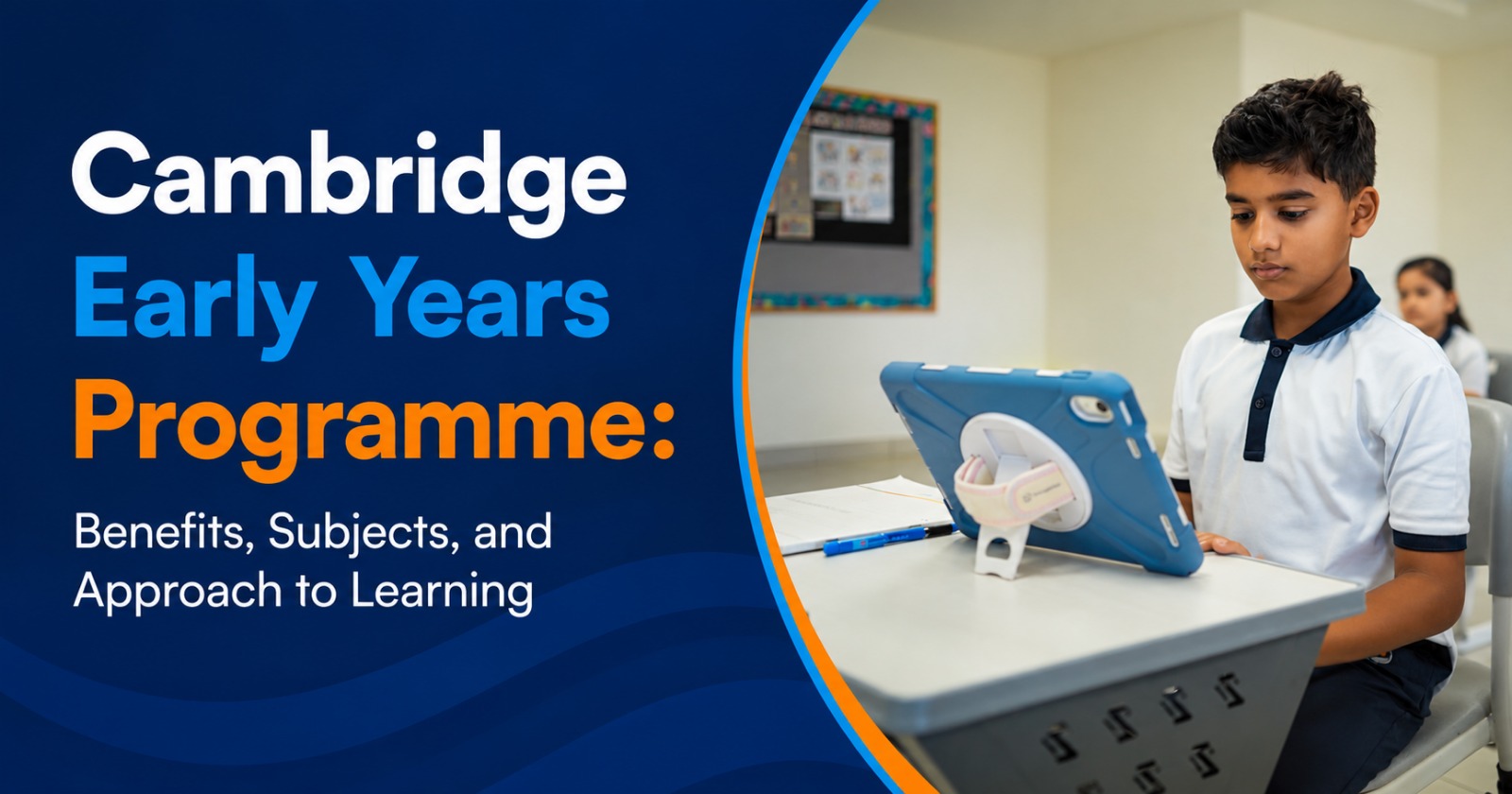
The key to a child’s education is the foundation set by the first years of life. The Cambridge Early Years Programme is for children from the age of 3 to 5, helping to develop the skills, curiosity and confidence that are essential before children enter formal school. Being familiar with this early phase helps parents to understand the rationale behind its implementation by many schools around the world, even by a growing number of schools in Uttar Pradesh, India.
What Is the Cambridge Early Years Programme
The Cambridge Early Years Programme is one of the Cambridge International Education (CAIE) pathway of programmes. It comes before the Cambridge Primary and is based on structured learning that is grounded in play to promote language, mathematics, personal and social development and physical growth in the young learner.
The programme is not a strict one of rote learning but allows children to explore, ask questions, and learn through guided activities. The children’s progress is monitored through observation, not through exams, and each child’s progress is recorded across seven areas of learning that are in line with the international early years standards.
Why Parents Choose a Cambridge Preschool
Learning to read and count is only part of what is provided at a Cambridge Preschool. It creates a learning pace that will last throughout all the years of schooling. Some of the reasons that parents choose this option are:
- Global curriculum consistency, that is, the continuity of the academic framework for a child moving from city to city or country to country.
- A skill-based foundation covering communication, problem-solving and social-emotional development, not just early academics.
- The use of trained educators, with the correct teaching approach and lesson structures from Cambridge.
- Smooth transition to Cambridge Primary and Cambridge Lower Secondary and onto Cambridge IGCSE and A Level.
Subjects and Learning Areas Covered
The programme is structured around seven core learning areas and not around subjects:
- Communication, language and literacy — students will grow in their love of books, build vocabulary and improve listening skills
- Mathematics — number sense, shapes, patterns and problem-solving through play
- Understanding the world — science, technology and cultural awareness
- Physical development — fine and gross motor skills, movement and handling
- Personal, social and emotional development — confidence, cooperation and self-regulation
- Expressive arts and design — creativity through art, music and imaginative play
- Digital literacy fundamentals — age-appropriate introduction to technology
This helps to ensure that children are not only academically ready for the next step but also developmentally ready.
The Cambridge Approach to Learning
A key difference between the Cambridge Early Years Programme and traditional preschools is its approach to learning, which is focused on inquiry. Children are asked “why” and “how” and teachers design lessons around children’s questions rather than around memorisation.
The classroom is usually set up in a blended way, consisting of guided play, group activities and individual attention. Assessment is ongoing and observational, allowing teachers and parents to have a good understanding of a child’s development without being subjected to formal testing at this early age.
It also provides a foundation for the analytical thinking skills students will be required to develop later in the Cambridge A Level Curriculum, when independent thinking and subject depth become key components to doing well.
Cambridge Education in Uttar Pradesh
Structured international curriculum is becoming more popular in Tier 2 and Tier 3 cities of UP. A Cambridge international school in Uttar Pradesh provides local families with access to an education that is on par with international standards, without having to move to a metro city.
This academic journey begins at the Early Years level and continues through the Primary and Cambridge Lower Secondary levels, available in and around Hathras district through a Cambridge Primary School in Sasni. This local access is significant, especially for families who are interested in an international curriculum but who would prefer to attend a school within their own community.
How Early Years Prepares Students for What Comes Next
The progression from Early Years to Cambridge Primary is planned to be smooth rather than abrupt. The skills acquired in these early years are closely related to and influence the more formal learning of subject matter that starts in Primary school.
Students have already been introduced to enquiry-based learning, independent thinking and continuous assessment, all of which stem from the Early Years foundation, by the time they are at Cambridge Lower Secondary.
Conclusion
The Cambridge Early Years Programme provides a solid academic and developmental base for young learners using the principles of curiosity, structured play and global learning outcomes. This programme offers parents a clear, well-supported introduction to Cambridge international education through early education, and continuing through to Cambridge A Level.
Frequently Asked Questions
In what age range is the Cambridge Early Years Programme for?
It is a programme for children aged 3–5 years, prior to entry to Cambridge Primary.
Is the Cambridge Early Years Programme exam based?
No. Assessment is ongoing and based on developmental progress, not on formal testing.
How is Early Years related to Cambridge Primary and beyond?
It develops fundamental skills in literacy, numeracy and social development which transfer directly into Cambridge Primary, Cambridge Lower Secondary and ultimately Cambridge IGCSE and A Level.
Do you have a Cambridge international school near Sasni, Uttar Pradesh?
Yes, there is a Cambridge Primary School in Sasni that provides this curriculum in the Hathras district.
Why opt for a Cambridge Preschool rather than a traditional preschool?
A Cambridge Preschool uses a curriculum that is benchmarked internationally, has clearly defined learning areas, trained teachers and a defined academic progression pathway.